Evolutionary ecology of words
作者: Reiji Suzuki, Takaya Arita
分类: q-bio.PE, cs.AI, cs.CL
发布日期: 2025-05-09
备注: 8 pages, 5 figures. Preprint of the paper published in Proceedings of 2025 IEEE Symposium on Computational Intelligence in Artificial Life and Cooperative Intelligent Systems (ALIFE-CIS)
期刊: Proceedings of 2025 IEEE Symposium on Computational Intelligence in Artificial Life and Cooperative Intelligent Systems (ALIFE-CIS), pp. 1-7 (2025)
DOI: 10.1109/ALIFE-CIS64968.2025.10979831
💡 一句话要点
提出基于LLM的词语进化生态模型以扩展进化博弈理论
🎯 匹配领域: 支柱九:具身大模型 (Embodied Foundation Models)
关键词: 进化博弈理论 大型语言模型 生态模型 语言进化 代理模型 物种共存 互动机制
📋 核心要点
- 现有的进化博弈理论和基于代理的模型在处理语言进化和互动方面存在局限性,难以模拟复杂的语言生态系统。
- 论文提出了一种基于大型语言模型的词语进化生态模型,允许代理通过语言互动进行进化,增强了模型的表达能力和适应性。
- 实验结果表明,模型能够有效模拟多样化物种的进化过程,且在不同环境中展示了物种的共存与竞争现象。
📝 摘要(中文)
我们提出了一种词语进化生态模型,旨在通过利用大型语言模型(LLMs)的丰富语言表达,扩展进化博弈理论和基于代理的模型。该模型允许代理之间出现和进化多样且无限的互动选项。每个代理在空间环境中移动,拥有由LLM生成的短词或短语。当代理相邻时,其互动结果由LLM根据词语之间的关系决定,失败者的词被胜利者的词替代。我们进行了初步实验,假设“强动物种”将存活,结果显示从初始的知名物种中,许多物种逐渐和以突发平衡的方式出现。每次试验展示了多样化种群的独特进化,某类大型物种如陆生动物、海洋生物或灭绝物种成为主导,适应于不同极端栖息地。我们还进行了长期实验,展示了多样物种的出现与共存。
🔬 方法详解
问题定义:本研究旨在解决现有进化博弈理论和基于代理模型在语言进化模拟中的不足,尤其是在多样化互动和生态适应性方面的挑战。
核心思路:通过引入大型语言模型(LLMs),本研究设计了一种新的模型,使得代理能够通过语言进行互动并进化,进而模拟复杂的语言生态系统。
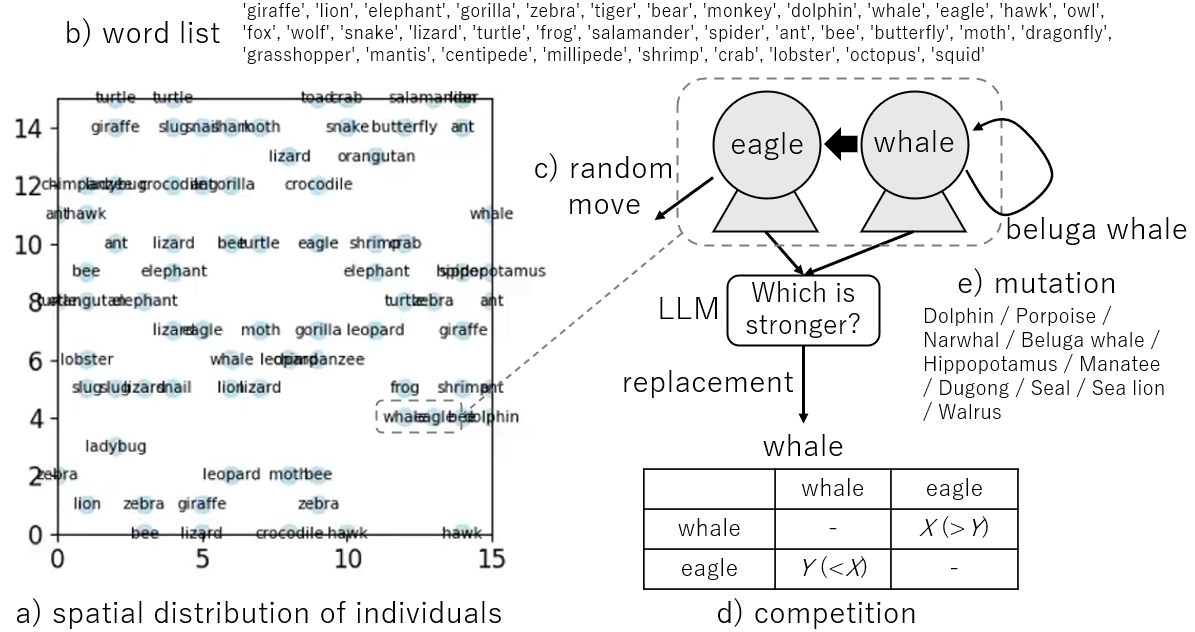
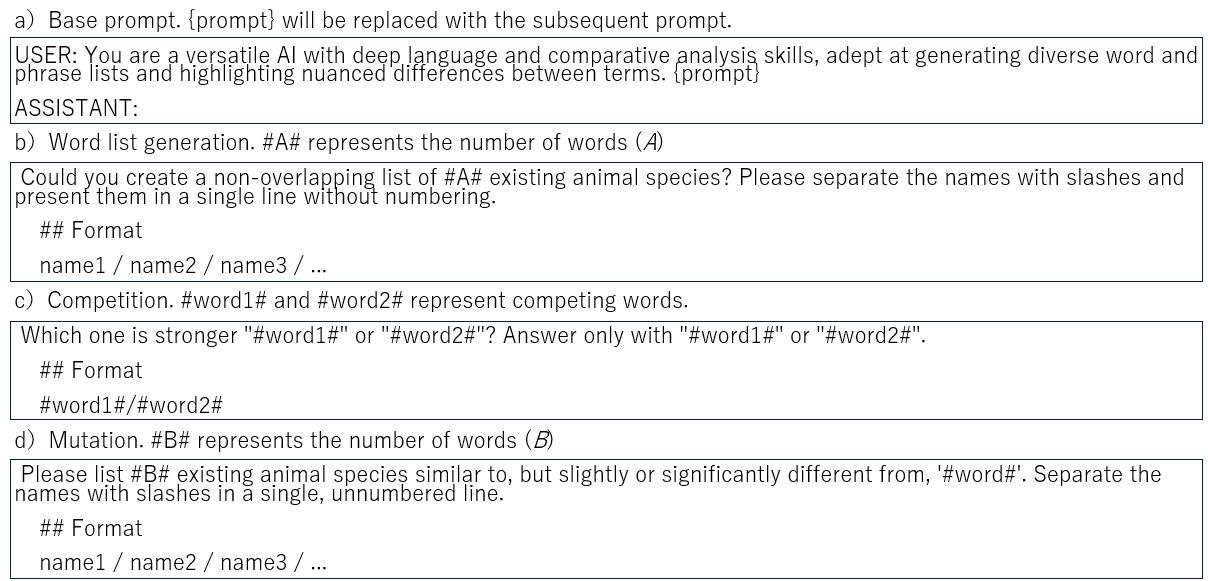
技术框架:模型包括多个代理,每个代理拥有由LLM生成的短词或短语,代理在空间环境中移动并相互接触。互动结果由LLM根据词语关系决定,失败者的词被胜利者的词替代,且可能发生词语突变。
关键创新:本研究的创新在于将LLM应用于进化生态模型中,使得语言的生成与进化过程更加真实和动态,突破了传统模型的局限。
关键设计:模型中设置了代理的移动规则、互动机制和词语突变机制,使用LLM生成词语并决定互动结果,确保了模型的灵活性和适应性。实验中还考虑了不同物种的生存策略和生态适应性。
🖼️ 关键图片
📊 实验亮点
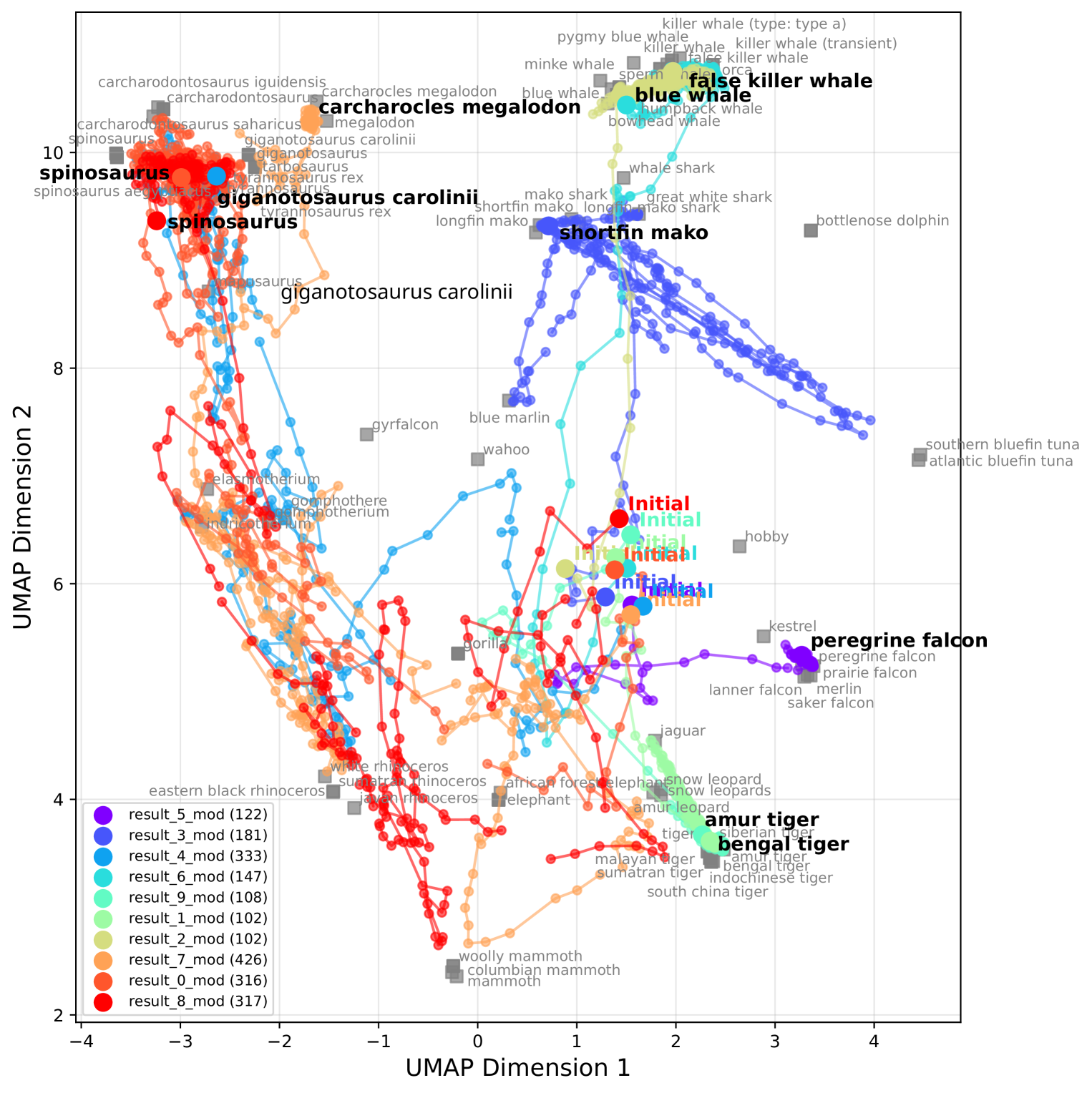
实验结果显示,模型能够有效模拟多样化物种的进化过程,初始物种中出现了多个新物种,并且某类大型物种在不同环境中表现出主导地位,验证了模型在生态适应性和语言互动方面的有效性。
🎯 应用场景
该研究的潜在应用领域包括语言学习、人工智能对话系统和生态模拟等。通过模拟语言的进化过程,可以为理解人类语言的起源和发展提供新的视角,同时也为自然语言处理领域的算法设计提供启示。
📄 摘要(原文)
We propose a model for the evolutionary ecology of words as one attempt to extend evolutionary game theory and agent-based models by utilizing the rich linguistic expressions of Large Language Models (LLMs). Our model enables the emergence and evolution of diverse and infinite options for interactions among agents. Within the population, each agent possesses a short word (or phrase) generated by an LLM and moves within a spatial environment. When agents become adjacent, the outcome of their interaction is determined by the LLM based on the relationship between their words, with the loser's word being replaced by the winner's. Word mutations, also based on LLM outputs, may occur. We conducted preliminary experiments assuming that ``strong animal species" would survive. The results showed that from an initial population consisting of well-known species, many species emerged both gradually and in a punctuated equilibrium manner. Each trial demonstrated the unique evolution of diverse populations, with one type of large species becoming dominant, such as terrestrial animals, marine life, or extinct species, which were ecologically specialized and adapted ones across diverse extreme habitats. We also conducted a long-term experiment with a large population, demonstrating the emergence and coexistence of diverse species.