Adopting Large Language Models to Automated System Integration
作者: Robin D. Pesl
分类: cs.SE, cs.AI
发布日期: 2025-04-11 (更新: 2025-07-28)
备注: This preprint has not undergone peer review (when applicable) or any post-submission improvements or corrections. The Version of Record of this contribution is published in Intelligent Information Systems. CAiSE 2025. Lecture Notes in Business Information Processing, vol 557. Springer, Cham., and is available online at https://doi.org/10.1007/978-3-031-94590-8_37
期刊: Intelligent Information Systems. CAiSE 2025. Lecture Notes in Business Information Processing, vol 557. Springer, Cham
DOI: 10.1007/978-3-031-94590-8_37
💡 一句话要点
利用大型语言模型实现自动化系统集成,简化服务组合流程。
🎯 匹配领域: 支柱九:具身大模型 (Embodied Foundation Models)
关键词: 大型语言模型 自动化服务组合 自然语言处理 服务发现 检索增强生成
📋 核心要点
- 现有服务组合方法依赖复杂的形式化建模,导致实践中应用受限,难以满足快速变化的企业需求。
- 利用大型语言模型理解自然语言输入,自动生成可重用的服务组合代码,降低集成工程师的工作负担。
- 提出Compositio Prompto架构,分析RAG在服务发现中的应用,并构建自然语言查询驱动的服务发现基准。
📝 摘要(中文)
现代企业计算系统通过集成多个子系统来完成通用任务,从而产生涌现行为。一种广泛使用的方法是使用Web技术(如REST或OpenAPI)实现的服务,它们分别提供交互机制和服务文档标准。每个服务代表特定的业务功能,从而实现封装和更轻松的维护。尽管单个服务级别的维护成本降低,但集成复杂性却增加了。因此,出现了自动化服务组合方法来缓解此问题。然而,由于这些方法依赖于复杂的正式建模,因此在实践中尚未获得高度认可。在本博士论文中,我们分析了大型语言模型(LLM)在基于自然语言输入自动集成服务中的应用。结果是可重用的服务组合,例如作为程序代码。虽然并非总是生成完全正确的结果,但该结果仍然有用,因为它为集成工程师提供了合适的解决方案的近似值,只需很少的精力即可投入使用。我们的研究包括(i)引入使用LLM进行自动化服务组合的软件架构,(ii)分析检索增强生成(RAG)以进行服务发现,(iii)提出一种新颖的基于自然语言查询的服务发现基准,以及(iv)将基准扩展到完整的服务组合场景。我们已经介绍了我们的软件架构Compositio Prompto,对RAG进行服务发现的分析,并提交了服务发现基准的提案。开放的主题主要是将服务发现基准扩展到服务组合场景以及改进服务组合生成,例如使用微调或LLM代理。
🔬 方法详解
问题定义:现有自动化服务组合方法依赖于复杂的形式化建模,这使得它们难以被实际应用。集成工程师需要一种更直观、更易于使用的方法来快速组合服务,以响应不断变化的业务需求。现有方法的痛点在于建模复杂性高,学习曲线陡峭,难以适应大规模服务集成。
核心思路:本研究的核心思路是利用大型语言模型(LLM)的自然语言理解和生成能力,将服务组合问题转化为一个自然语言处理任务。通过自然语言描述服务组合的需求,LLM可以自动生成相应的服务组合代码。这种方法避免了复杂的形式化建模,降低了集成工程师的学习成本。
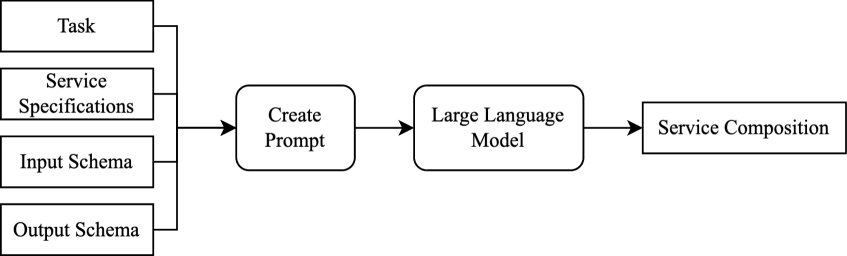
技术框架:论文提出了Compositio Prompto架构,该架构包含以下主要模块:1) 自然语言输入模块:接收用户以自然语言描述的服务组合需求。2) 服务发现模块:利用检索增强生成(RAG)技术,从服务注册中心检索相关的服务信息。3) 服务组合生成模块:使用LLM根据自然语言需求和服务信息生成服务组合代码。4) 代码验证模块(未知):验证生成的代码是否符合预期功能。
关键创新:本研究的关键创新在于将大型语言模型应用于自动化服务组合领域,并提出了一种基于自然语言查询的服务发现方法。与传统方法相比,该方法无需复杂的形式化建模,降低了集成工程师的学习成本,提高了服务组合的效率。
关键设计:论文重点分析了检索增强生成(RAG)技术在服务发现中的应用,并提出了一个新颖的基于自然语言查询的服务发现基准。具体的参数设置、损失函数、网络结构等技术细节在摘要中未提及,属于未知信息。未来的工作将包括改进服务组合生成,例如使用微调或LLM代理。
🖼️ 关键图片

📊 实验亮点
论文提出了Compositio Prompto软件架构,并分析了RAG在服务发现中的应用。此外,论文还提出了一个新颖的基于自然语言查询的服务发现基准。具体的性能数据和提升幅度在摘要中未提及,属于未知信息。
🎯 应用场景
该研究成果可应用于企业应用集成、云计算服务编排、物联网设备互联等领域。通过降低服务组合的复杂性,可以加速应用开发和部署,提高企业IT系统的灵活性和响应速度。未来,该技术有望实现更加智能化的服务组合,自动适应不断变化的业务需求。
📄 摘要(原文)
Modern enterprise computing systems integrate numerous subsystems to resolve a common task by yielding emergent behavior. A widespread approach is using services implemented with Web technologies like REST or OpenAPI, which offer an interaction mechanism and service documentation standard, respectively. Each service represents a specific business functionality, allowing encapsulation and easier maintenance. Despite the reduced maintenance costs on an individual service level, increased integration complexity arises. Consequently, automated service composition approaches have arisen to mitigate this issue. Nevertheless, these approaches have not achieved high acceptance in practice due to their reliance on complex formal modeling. Within this Ph.D. thesis, we analyze the application of Large Language Models (LLMs) to automatically integrate the services based on a natural language input. The result is a reusable service composition, e.g., as program code. While not always generating entirely correct results, the result can still be helpful by providing integration engineers with a close approximation of a suitable solution, which requires little effort to become operational. Our research involves (i) introducing a software architecture for automated service composition using LLMs, (ii) analyzing Retrieval Augmented Generation (RAG) for service discovery, (iii) proposing a novel natural language query-based benchmark for service discovery, and (iv) extending the benchmark to complete service composition scenarios. We have presented our software architecture as Compositio Prompto, the analysis of RAG for service discovery, and submitted a proposal for the service discovery benchmark. Open topics are primarily the extension of the service discovery benchmark to service composition scenarios and the improvements of the service composition generation, e.g., using fine-tuning or LLM agents.