Consolidating TinyML Lifecycle with Large Language Models: Reality, Illusion, or Opportunity?
作者: Guanghan Wu, Sasu Tarkoma, Roberto Morabito
分类: cs.SE, cs.AI, cs.LG
发布日期: 2025-01-20 (更新: 2025-04-05)
备注: This paper has been accepted for publication in the IEEE Internet of Things Magazine (Special Issue on Applications of Large Language Models in IoT). The copyright will be transferred to IEEE upon publication. A preliminary version of this work was presented at the Edge AI Foundation event Beyond LLMs and Chatbots: The Journey to Generative AI at the Edge (https://youtu.be/aFWfisdjQIs)
💡 一句话要点
利用大语言模型简化TinyML生命周期,探索其现实性与机遇
🎯 匹配领域: 支柱九:具身大模型 (Embodied Foundation Models)
关键词: TinyML 大语言模型 自动化 物联网 边缘计算
📋 核心要点
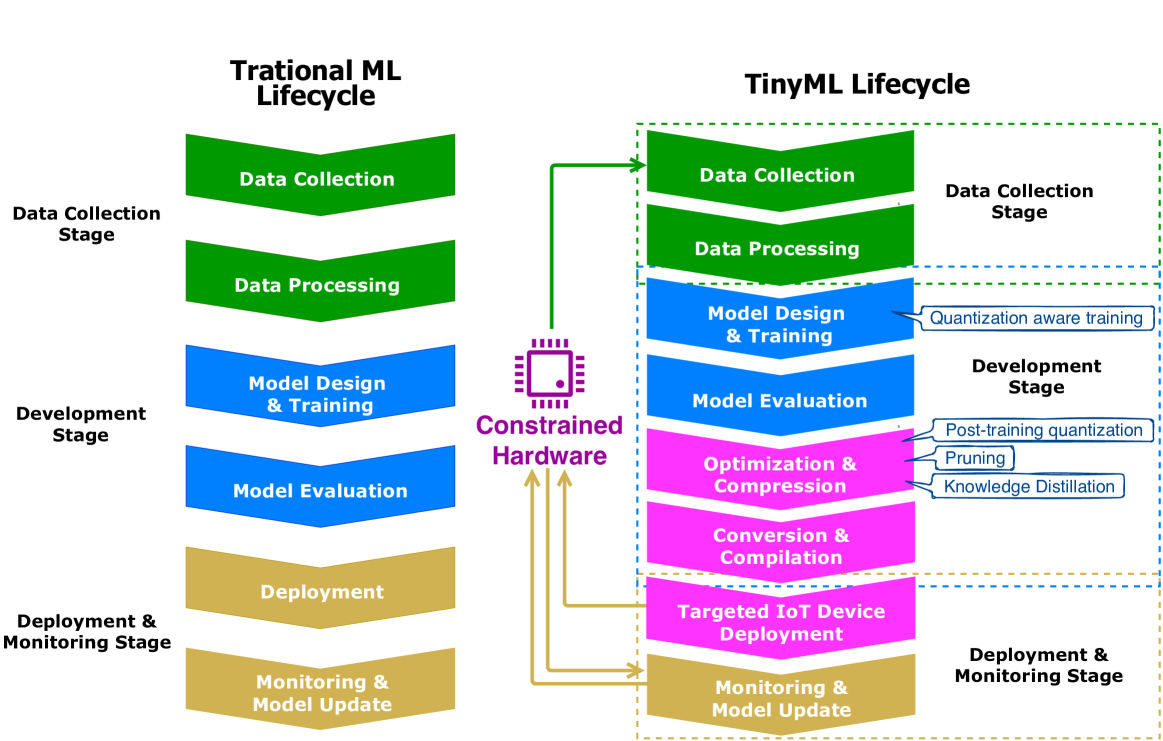
- 现有TinyML生命周期管理复杂,数据处理、模型优化和部署都需要大量人工干预,效率低下。
- 利用LLM的NLP和代码生成能力,构建自动化框架,旨在减少开发时间并降低TinyML部署的门槛。
- 通过计算机视觉分类案例研究,验证了框架自动化TinyML关键阶段的能力,表明LLM具有改进生命周期的潜力。
📝 摘要(中文)
物联网(IoT)应用不断发展的需求推动了将智能引入边缘的趋势,从而能够在资源受限的环境中实现实时洞察和决策。TinyML是这一演进的关键推动者,它促进了ML模型在微控制器和嵌入式系统等设备上的部署。然而,管理TinyML生命周期的复杂性,包括数据处理、模型优化与转换以及设备部署等阶段,带来了重大挑战,并且通常需要大量的人工干预。为了应对这些挑战,我们开始探索大语言模型(LLM)是否可以帮助自动化和简化TinyML生命周期。我们开发了一个框架,利用LLM的自然语言处理(NLP)和代码生成能力来减少开发时间,并降低TinyML部署的门槛。通过一个涉及计算机视觉分类模型的案例研究,我们展示了该框架自动化TinyML生命周期关键阶段的能力。我们的研究结果表明,基于LLM的自动化具有改进生命周期开发过程和适应多样化要求的潜力。然而,尽管这种方法显示出前景,但仍然存在障碍和局限性,尤其是在实现完全自动化解决方案方面。本文阐明了将LLM集成到TinyML工作流程中的挑战和机遇,为高效的AI辅助嵌入式系统开发提供了前进方向的见解。
🔬 方法详解
问题定义:TinyML生命周期管理复杂,包括数据处理、模型优化与转换、设备部署等环节,需要大量人工干预,开发周期长,门槛高。现有方法难以实现全自动化,效率提升有限。
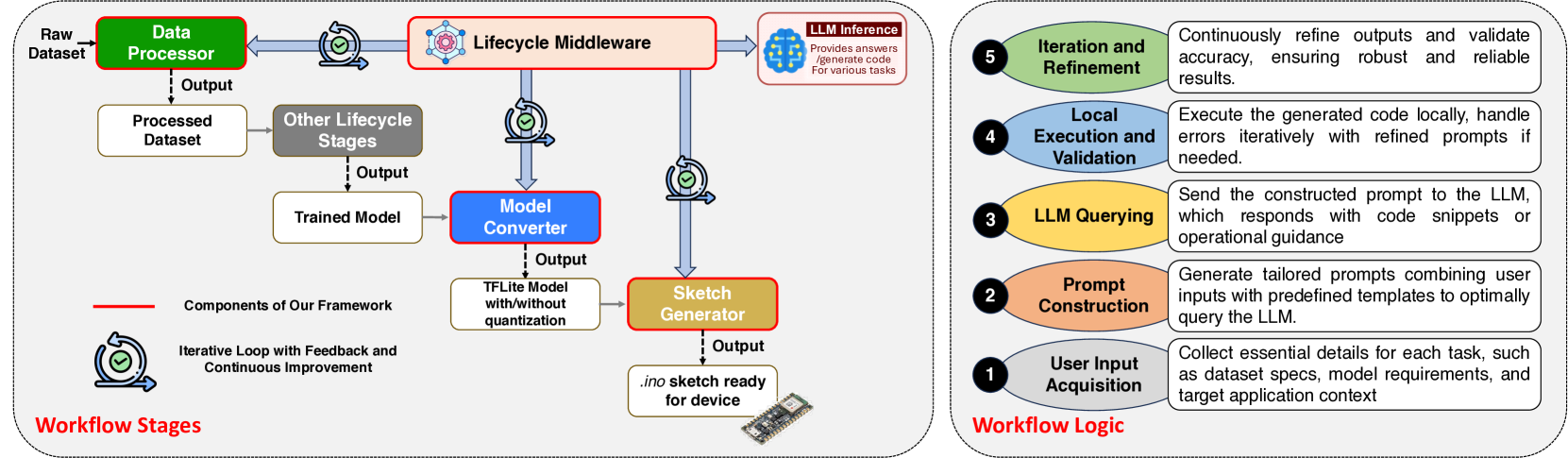
核心思路:利用大语言模型(LLM)的自然语言处理和代码生成能力,将TinyML生命周期中的各个环节进行自动化。通过自然语言指令,驱动LLM生成相应的代码和配置,从而简化开发流程。核心在于将复杂的TinyML任务转化为LLM可以理解和执行的自然语言指令。
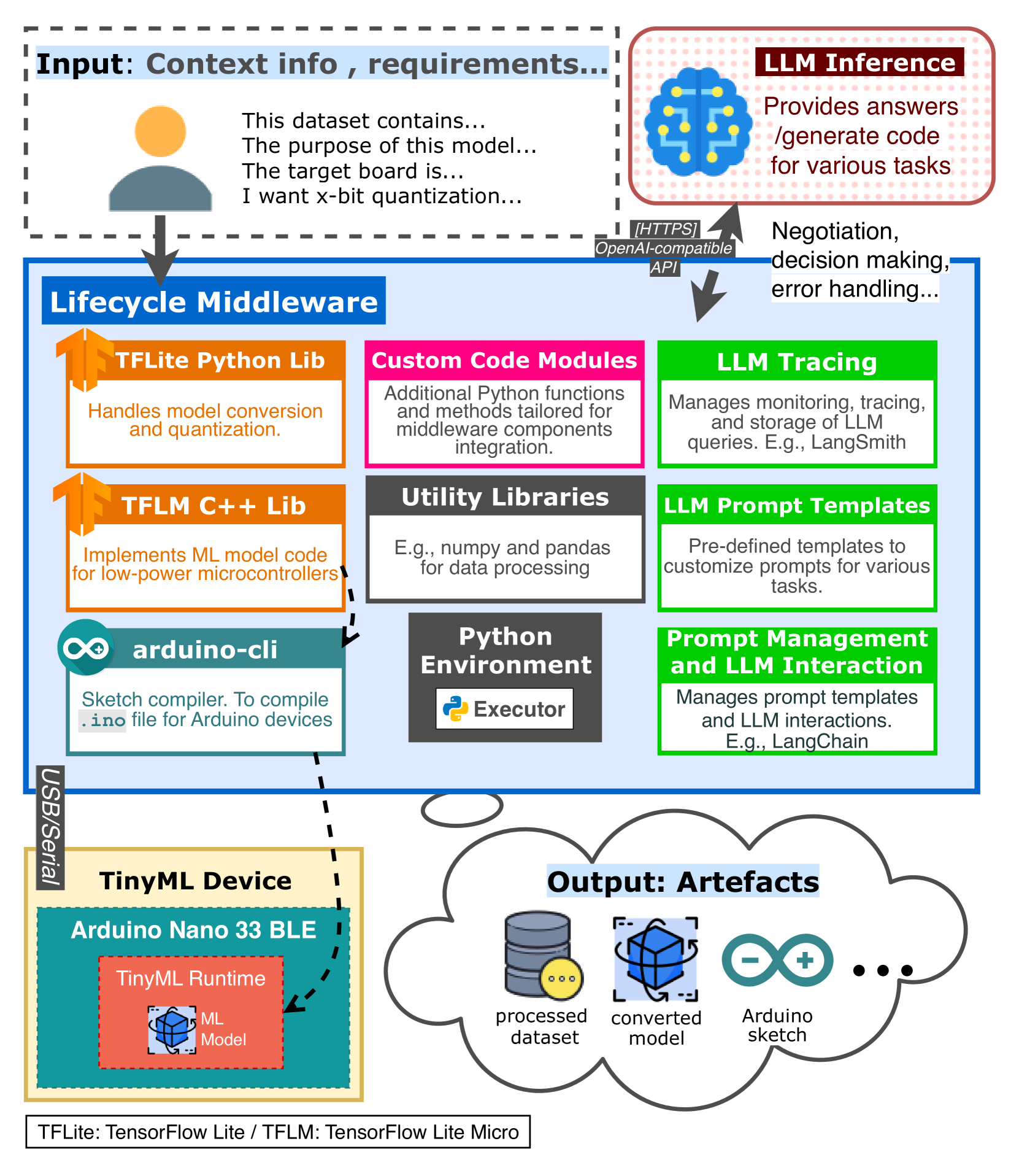
技术框架:该框架主要包含以下几个阶段:1) 用户通过自然语言描述TinyML任务需求;2) LLM解析用户需求,生成相应的代码和配置文件,例如模型训练脚本、模型转换脚本、设备部署脚本等;3) 框架执行生成的代码和配置文件,完成TinyML模型的训练、优化和部署;4) 框架提供反馈和调试接口,允许用户根据实际情况调整LLM生成的代码和配置。
关键创新:该论文的关键创新在于将LLM引入TinyML生命周期管理,利用LLM的通用性和强大的代码生成能力,实现了TinyML开发流程的自动化。与传统的手动开发方式相比,该方法可以显著减少开发时间和人力成本。与现有的自动化工具相比,该方法更加灵活,可以适应不同的TinyML任务需求。
关键设计:论文中没有详细描述关键参数设置、损失函数、网络结构等技术细节。但是,可以推断,LLM的选择和Prompt的设计是关键。需要选择具有较强代码生成能力的LLM,并设计合适的Prompt,引导LLM生成高质量的代码和配置文件。此外,还需要设计有效的反馈和调试机制,允许用户根据实际情况调整LLM生成的代码和配置。
🖼️ 关键图片
📊 实验亮点
论文通过一个计算机视觉分类模型的案例研究,展示了该框架自动化TinyML生命周期关键阶段的能力。虽然论文没有给出具体的性能数据,但强调了LLM在简化开发流程和降低开发门槛方面的潜力。研究结果表明,基于LLM的自动化具有改进生命周期开发过程和适应多样化要求的潜力。
🎯 应用场景
该研究成果可应用于各种物联网场景,例如智能家居、智能农业、工业自动化等。通过自动化TinyML模型的开发和部署,可以降低边缘智能应用的开发成本,加速边缘智能的普及。例如,在智能农业中,可以使用该方法快速开发和部署农作物病虫害识别模型,从而提高农业生产效率。
📄 摘要(原文)
The evolving requirements of Internet of Things (IoT) applications are driving an increasing shift toward bringing intelligence to the edge, enabling real-time insights and decision-making within resource-constrained environments. Tiny Machine Learning (TinyML) has emerged as a key enabler of this evolution, facilitating the deployment of ML models on devices such as microcontrollers and embedded systems. However, the complexity of managing the TinyML lifecycle, including stages such as data processing, model optimization and conversion, and device deployment, presents significant challenges and often requires substantial human intervention. Motivated by these challenges, we began exploring whether Large Language Models (LLMs) could help automate and streamline the TinyML lifecycle. We developed a framework that leverages the natural language processing (NLP) and code generation capabilities of LLMs to reduce development time and lower the barriers to entry for TinyML deployment. Through a case study involving a computer vision classification model, we demonstrate the framework's ability to automate key stages of the TinyML lifecycle. Our findings suggest that LLM-powered automation holds potential for improving the lifecycle development process and adapting to diverse requirements. However, while this approach shows promise, there remain obstacles and limitations, particularly in achieving fully automated solutions. This paper sheds light on both the challenges and opportunities of integrating LLMs into TinyML workflows, providing insights into the path forward for efficient, AI-assisted embedded system development.