GenAI-powered Multi-Agent Paradigm for Smart Urban Mobility: Opportunities and Challenges for Integrating Large Language Models (LLMs) and Retrieval-Augmented Generation (RAG) with Intelligent Transportation Systems
作者: Haowen Xu, Jinghui Yuan, Anye Zhou, Guanhao Xu, Wan Li, Xuegang Ban, Xinyue Ye
分类: cs.AI, cs.SE
发布日期: 2024-08-31 (更新: 2024-09-04)
💡 一句话要点
提出基于GenAI的多智能体框架,利用LLM和RAG提升智能交通系统性能
🎯 匹配领域: 支柱九:具身大模型 (Embodied Foundation Models)
关键词: 智能交通系统 多智能体系统 大型语言模型 检索增强生成 城市交通 生成式人工智能 交通管理
📋 核心要点
- 传统智能交通系统依赖固定知识库和有限推理能力,难以应对复杂多变的城市交通场景。
- 论文提出基于LLM和RAG的多智能体系统框架,旨在实现更智能、可扩展和自动化的交通管理。
- 该框架旨在减少交通拥堵、事故和碳排放,促进公众参与,并自动化交通管理任务。
📝 摘要(中文)
本文探讨了生成式人工智能(GenAI)的最新进展,特别是大型语言模型(LLM)和检索增强生成(RAG)技术在智能交通系统(ITS)中的变革潜力,旨在为解决城市交通的关键挑战提供创新方案。首先,全面概述了移动数据、ITS和车联网(CV)应用的最新技术。在此基础上,讨论了RAG背后的原理,并探讨了将这些GenAI技术集成到智能交通领域的机遇。提出了一个概念框架,旨在开发能够以智能化和对话方式向城市通勤者、交通运营商和决策者提供智能交通服务的多智能体系统。该方法旨在促进一种自主和智能的方法,从而在多个尺度上减少交通拥堵、事故和碳排放,促进公众教育和参与式交通管理,并自动化专门的交通管理任务和关键ITS平台的开发,例如数据分析和解释、知识表示和交通模拟。通过集成LLM和RAG,旨在克服传统基于规则的多智能体系统的局限性,从而推动ITS和城市交通的进步。
🔬 方法详解
问题定义:现有智能交通系统(ITS)中的多智能体系统通常依赖于预定义的规则和固定的知识库,这限制了它们在复杂和动态的城市交通环境中进行有效推理和决策的能力。传统方法难以处理非结构化数据,缺乏自然语言交互能力,并且难以适应新的交通模式和突发事件。
核心思路:本文的核心思路是将大型语言模型(LLM)和检索增强生成(RAG)技术集成到多智能体系统中,从而增强智能体的推理、对话和知识获取能力。通过利用LLM的强大语言理解和生成能力,以及RAG从外部知识库检索相关信息的能力,可以使智能体更有效地理解用户需求、分析交通状况并做出明智的决策。
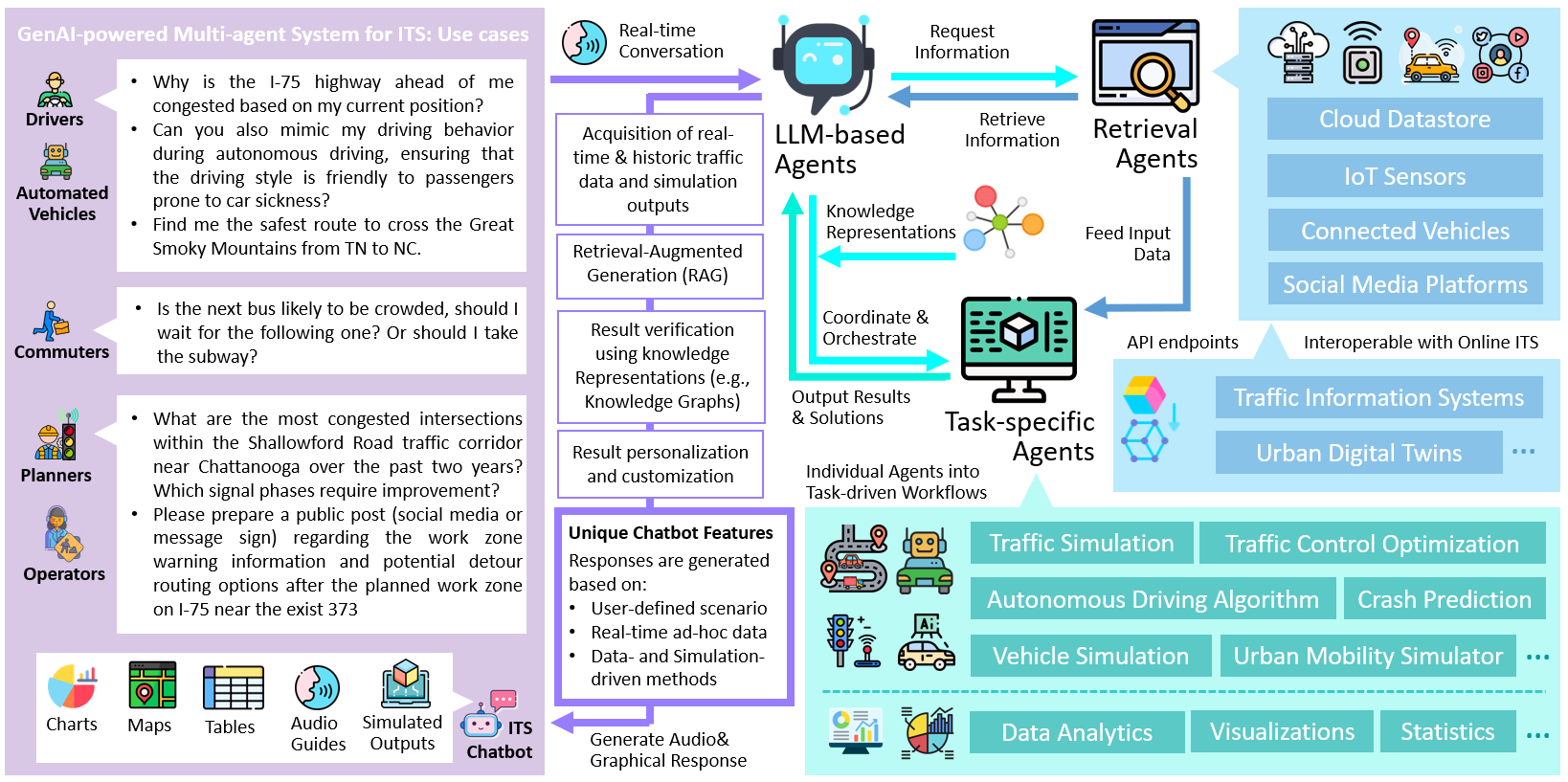
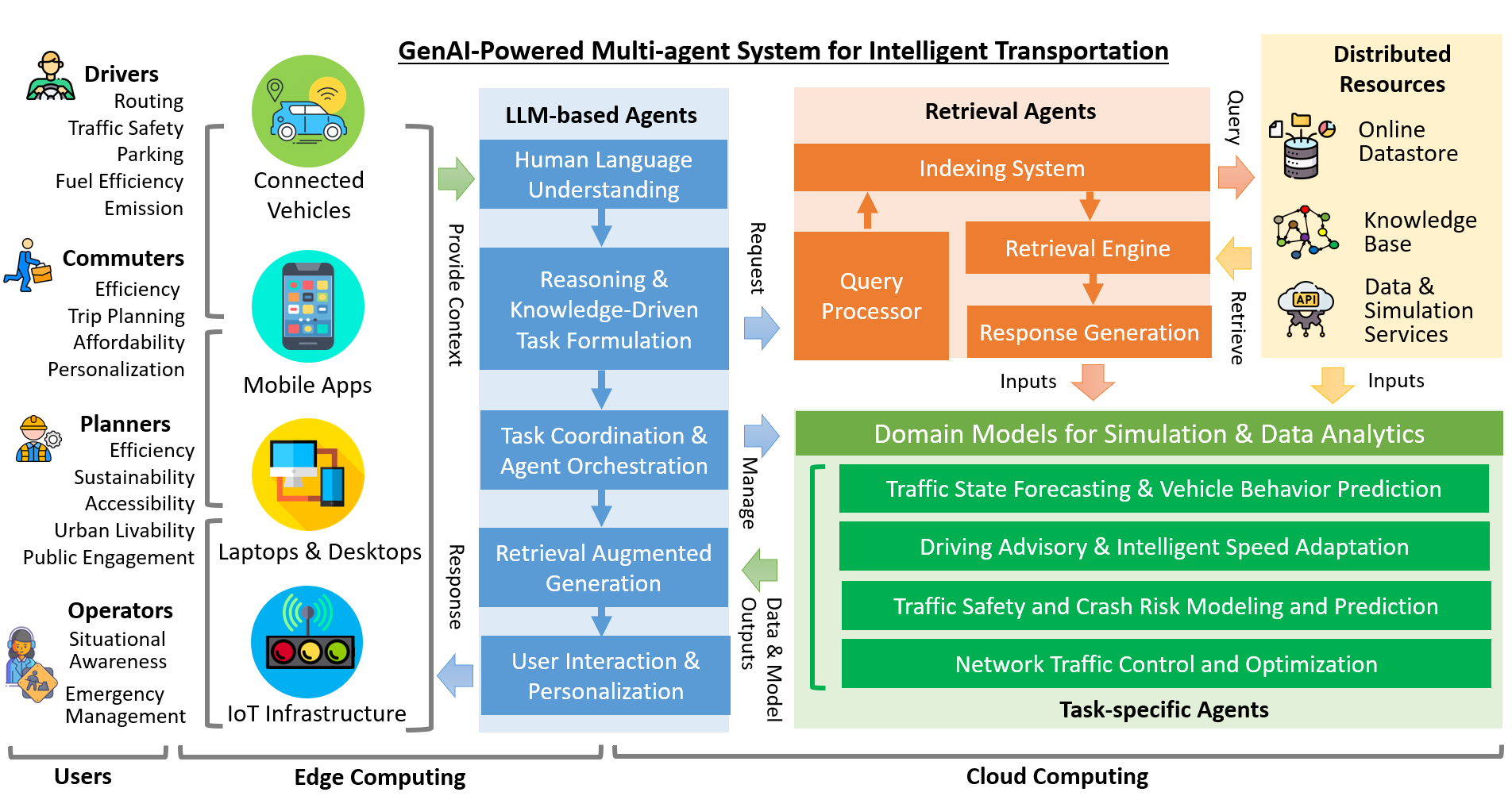
技术框架:该框架包含多个智能体,每个智能体负责特定的任务,例如交通流量预测、路径规划或事故响应。这些智能体通过消息传递进行协作,并共享从LLM和RAG获得的信息。整体流程包括:1) 用户输入自然语言查询或指令;2) 智能体利用LLM理解用户意图;3) 智能体使用RAG从外部知识库检索相关信息;4) 智能体基于检索到的信息和LLM的推理结果做出决策;5) 智能体将决策结果以自然语言形式呈现给用户或执行相应的操作。
关键创新:最重要的技术创新点在于将LLM和RAG技术无缝集成到多智能体系统中,从而克服了传统基于规则的系统的局限性。与现有方法相比,该方法能够处理非结构化数据,支持自然语言交互,并能够根据实时交通状况动态调整策略。
关键设计:论文提出了一个概念框架,没有提供具体的参数设置或网络结构等技术细节。未来的研究可以探索不同的LLM和RAG模型,并针对特定的交通场景进行优化。例如,可以设计特定的损失函数来训练LLM,使其更好地理解交通相关的概念和关系。此外,还可以探索不同的知识库和检索策略,以提高RAG的效率和准确性。
🖼️ 关键图片
📊 实验亮点
由于是概念性框架论文,没有提供具体的实验结果。论文强调了集成LLM和RAG后,多智能体系统在处理非结构化数据、支持自然语言交互以及动态适应交通状况方面的潜力。未来的研究可以验证该框架在实际交通场景中的性能提升。
🎯 应用场景
该研究成果可应用于智能交通管理、自动驾驶、公共交通优化等领域。通过提供更智能、更高效的交通服务,可以改善城市交通拥堵状况,减少交通事故,降低碳排放,并提升城市居民的出行体验。未来,该技术有望推动智慧城市的发展,实现可持续的城市交通。
📄 摘要(原文)
Leveraging recent advances in generative AI, multi-agent systems are increasingly being developed to enhance the functionality and efficiency of smart city applications. This paper explores the transformative potential of large language models (LLMs) and emerging Retrieval-Augmented Generation (RAG) technologies in Intelligent Transportation Systems (ITS), paving the way for innovative solutions to address critical challenges in urban mobility. We begin by providing a comprehensive overview of the current state-of-the-art in mobility data, ITS, and Connected Vehicles (CV) applications. Building on this review, we discuss the rationale behind RAG and examine the opportunities for integrating these Generative AI (GenAI) technologies into the smart mobility sector. We propose a conceptual framework aimed at developing multi-agent systems capable of intelligently and conversationally delivering smart mobility services to urban commuters, transportation operators, and decision-makers. Our approach seeks to foster an autonomous and intelligent approach that (a) promotes science-based advisory to reduce traffic congestion, accidents, and carbon emissions at multiple scales, (b) facilitates public education and engagement in participatory mobility management, and (c) automates specialized transportation management tasks and the development of critical ITS platforms, such as data analytics and interpretation, knowledge representation, and traffic simulations. By integrating LLM and RAG, our approach seeks to overcome the limitations of traditional rule-based multi-agent systems, which rely on fixed knowledge bases and limited reasoning capabilities. This integration paves the way for a more scalable, intuitive, and automated multi-agent paradigm, driving advancements in ITS and urban mobility.