Do We Really Need a Complex Agent System? Distill Embodied Agent into a Single Model
作者: Zhonghan Zhao, Ke Ma, Wenhao Chai, Xuan Wang, Kewei Chen, Dongxu Guo, Yanting Zhang, Hongwei Wang, Gaoang Wang
分类: cs.AI, cs.CV
发布日期: 2024-04-06
备注: arXiv admin note: text overlap with arXiv:2403.08282
💡 一句话要点
提出STEVE-2以简化复杂体代理系统
🎯 匹配领域: 支柱二:RL算法与架构 (RL & Architecture) 支柱九:具身大模型 (Embodied Foundation Models)
关键词: 体代理 知识蒸馏 多模态学习 开放式任务 层次化系统 镜像蒸馏 智能机器人
📋 核心要点
- 现有的多模态语言模型(MLMs)在复杂任务执行中存在独立性和动态适应性不足的问题。
- 提出STEVE-2框架,通过层次化任务划分和镜像蒸馏方法,提升开放式体代理的执行能力。
- 实验结果表明,STEVE-2在导航和创作任务中表现优异,性能提升幅度达到1.4到7.3倍。
📝 摘要(中文)
随着大型语言模型(LLMs)的发展,开放式体代理能够灵活理解人类指令,生成可解释的指导策略并输出可执行动作。然而,现有方法存在多个问题:代理系统独立运行、训练数据静态且缺乏动态适应性、直接输入先验知识限制了灵活性。为此,本文提出了STEVE-2,一个层次化知识蒸馏框架,能够在无需额外专家指导的情况下完成复杂的开放式任务。通过对导航和创作任务的广泛评估,STEVE-2在开放式任务中的表现提升了1.4到7.3倍。
🔬 方法详解
问题定义:本文旨在解决现有体代理系统在复杂任务执行中的独立性和动态适应性不足的问题。现有方法通常依赖多个LLMs,导致任务执行与复杂性之间存在差距。
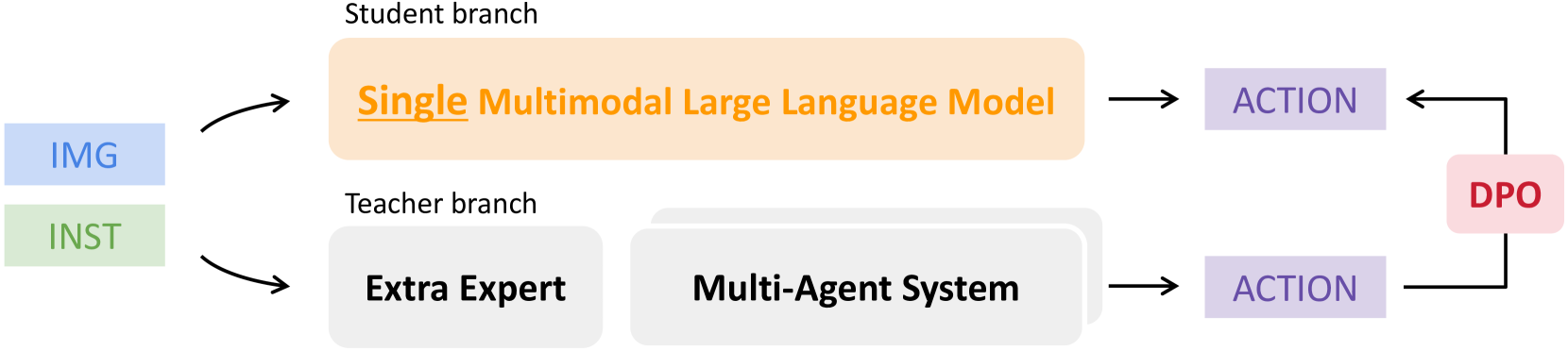
核心思路:STEVE-2通过层次化知识蒸馏框架,将复杂任务分解为多个子任务,并通过镜像蒸馏方法进行并行模拟,从而提升代理的执行能力。
技术框架:STEVE-2的整体架构包括三个主要模块:层次化任务划分模块、镜像蒸馏模块和专家模型模块。层次化任务划分模块负责将复杂任务分解为多个子任务,镜像蒸馏模块则通过并行模拟生成训练数据,专家模型模块引入额外知识以增强模型能力。
关键创新:STEVE-2的核心创新在于其层次化的任务划分和镜像蒸馏方法,这与现有方法的独立性和静态训练方式形成鲜明对比,使得代理能够在动态环境中更灵活地执行任务。
关键设计:在设计中,STEVE-2采用了特定的损失函数以优化蒸馏过程,并通过调整网络结构来适应多模态输入,确保模型在开放式任务中的表现达到最佳。
🖼️ 关键图片


📊 实验亮点
在导航和创作任务的广泛评估中,STEVE-2展示了显著的性能提升,具体表现为1.4到7.3倍的提升幅度,相较于传统方法,显示出更强的适应性和执行能力。
🎯 应用场景
STEVE-2框架的潜在应用场景包括智能机器人、自动驾驶、虚拟助手等领域,能够有效提升这些系统在复杂环境中的任务执行能力。其灵活的知识蒸馏方法也为未来的多模态学习提供了新的思路,具有重要的实际价值和研究意义。
📄 摘要(原文)
With the power of large language models (LLMs), open-ended embodied agents can flexibly understand human instructions, generate interpretable guidance strategies, and output executable actions. Nowadays, Multi-modal Language Models~(MLMs) integrate multi-modal signals into LLMs, further bringing richer perception to entity agents and allowing embodied agents to perceive world-understanding tasks more delicately. However, existing works: 1) operate independently by agents, each containing multiple LLMs, from perception to action, resulting in gaps between complex tasks and execution; 2) train MLMs on static data, struggling with dynamics in open-ended scenarios; 3) input prior knowledge directly as prompts, suppressing application flexibility. We propose STEVE-2, a hierarchical knowledge distillation framework for open-ended embodied tasks, characterized by 1) a hierarchical system for multi-granular task division, 2) a mirrored distillation method for parallel simulation data, and 3) an extra expert model for bringing additional knowledge into parallel simulation. After distillation, embodied agents can complete complex, open-ended tasks without additional expert guidance, utilizing the performance and knowledge of a versatile MLM. Extensive evaluations on navigation and creation tasks highlight the superior performance of STEVE-2 in open-ended tasks, with $1.4 \times$ - $7.3 \times$ in performance.