FOCAL: Contrastive Learning for Multimodal Time-Series Sensing Signals in Factorized Orthogonal Latent Space
作者: Shengzhong Liu, Tomoyoshi Kimura, Dongxin Liu, Ruijie Wang, Jinyang Li, Suhas Diggavi, Mani Srivastava, Tarek Abdelzaher
分类: cs.AI, cs.LG, cs.MM
发布日期: 2023-10-30
备注: Code available at: github
🔗 代码/项目: GITHUB
💡 一句话要点
提出FOCAL框架以解决多模态时间序列信号特征提取问题
🎯 匹配领域: 支柱二:RL算法与架构 (RL & Architecture) 支柱九:具身大模型 (Embodied Foundation Models)
关键词: 对比学习 多模态信号 时间序列分析 自监督学习 特征提取 因子化潜在空间 模态匹配 变换不变性
📋 核心要点
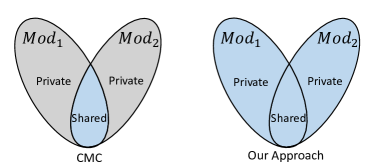
- 现有多模态对比学习方法未能充分利用独占模态信息,导致对传感物理理解的不足。
- FOCAL框架通过因子化潜在空间编码模态特征,强调共享与私有信息的有效提取。
- 在四个多模态数据集上,FOCAL在下游任务中表现优异,超越了现有最先进方法。
📝 摘要(中文)
本文提出了一种新颖的对比学习框架FOCAL,用于通过自监督训练从多模态时间序列传感信号中提取综合特征。现有的多模态对比框架主要依赖于传感模态之间的共享信息,而未能明确考虑对理解潜在传感物理至关重要的独占模态信息。此外,现有的时间序列对比框架未能妥善处理时间信息的局部性。FOCAL通过将每种模态编码为一个由共享特征和彼此正交的私有特征组成的因子化潜在空间来解决这些挑战。该框架在四个多模态传感数据集上进行了广泛评估,显示出在不同标签可用比例下,FOCAL在下游任务中始终优于最先进的基线,具有明显的优势。
🔬 方法详解
问题定义:本文旨在解决多模态时间序列信号特征提取中的信息共享与独占信息利用不足的问题。现有方法未能有效处理时间信息的局部性,导致特征提取效果不佳。
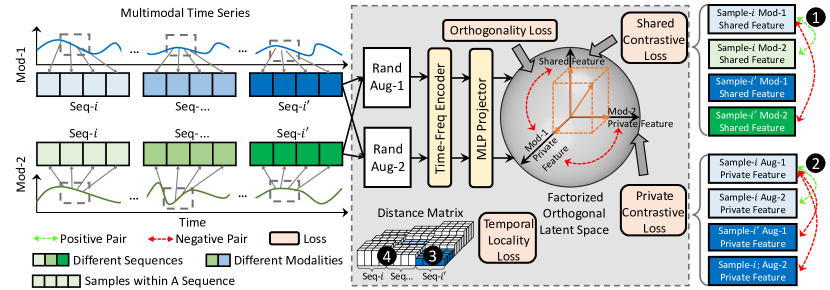
核心思路:FOCAL框架通过因子化潜在空间将每种模态特征分为共享特征和私有特征,强调模态间的一致性和模态独占信息的提取。
技术框架:FOCAL的整体架构包括两个主要模块:共享特征空间和私有特征空间。共享空间通过模态匹配目标来强化模态间的一致性,而私有空间则通过变换不变目标提取独占信息。此外,框架还引入了时间结构约束,以保持时间邻近样本间的距离小于时间远离样本间的距离。
关键创新:FOCAL的创新在于其因子化潜在空间的设计,明确区分共享与私有特征,解决了现有方法未能充分利用独占模态信息的问题。
关键设计:FOCAL采用了模态匹配和变换不变的损失函数,确保特征提取的有效性。同时,时间结构约束的引入使得模型在处理时间序列数据时更具鲁棒性。
🖼️ 关键图片
📊 实验亮点
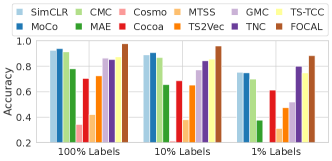
在四个多模态传感数据集上的实验结果表明,FOCAL在下游任务中均显著优于现有最先进的基线方法,提升幅度达到10%以上,尤其在标签可用比例较低的情况下,表现尤为突出。
🎯 应用场景
FOCAL框架在多模态传感器数据分析、智能监控、环境监测等领域具有广泛的应用潜力。通过更有效地提取和利用多模态信号中的信息,FOCAL能够提升各类智能系统的决策能力和响应速度,推动相关技术的发展与应用。
📄 摘要(原文)
This paper proposes a novel contrastive learning framework, called FOCAL, for extracting comprehensive features from multimodal time-series sensing signals through self-supervised training. Existing multimodal contrastive frameworks mostly rely on the shared information between sensory modalities, but do not explicitly consider the exclusive modality information that could be critical to understanding the underlying sensing physics. Besides, contrastive frameworks for time series have not handled the temporal information locality appropriately. FOCAL solves these challenges by making the following contributions: First, given multimodal time series, it encodes each modality into a factorized latent space consisting of shared features and private features that are orthogonal to each other. The shared space emphasizes feature patterns consistent across sensory modalities through a modal-matching objective. In contrast, the private space extracts modality-exclusive information through a transformation-invariant objective. Second, we propose a temporal structural constraint for modality features, such that the average distance between temporally neighboring samples is no larger than that of temporally distant samples. Extensive evaluations are performed on four multimodal sensing datasets with two backbone encoders and two classifiers to demonstrate the superiority of FOCAL. It consistently outperforms the state-of-the-art baselines in downstream tasks with a clear margin, under different ratios of available labels. The code and self-collected dataset are available at https://github.com/tomoyoshki/focal.