Enhancing Robotic Manipulation: Harnessing the Power of Multi-Task Reinforcement Learning and Single Life Reinforcement Learning in Meta-World
作者: Ghadi Nehme, Ishan Sabane, Tejas Y. Deo
分类: cs.AI, cs.RO
发布日期: 2023-10-23
💡 一句话要点
提出多任务强化学习与单生命周期强化学习结合以提升机器人操作能力
🎯 匹配领域: 支柱一:机器人控制 (Robot Control) 支柱二:RL算法与架构 (RL & Architecture)
关键词: 多任务强化学习 单生命周期强化学习 机器人操作 Meta World 软演员评论家 任务泛化 算法优化
📋 核心要点
- 现有的多任务强化学习算法在不同任务间的泛化能力不足,难以应对真实环境中的变化。
- 本文提出结合多任务软演员评论家(MT-SAC)与单生命周期强化学习(MT-QWALE)的方法,以提高机器人在多任务中的表现。
- 实验结果显示,MT-QWALE在新目标位置的任务完成率高于MT-SAC,且在隐藏目标位置时仍能有效完成任务。
📝 摘要(中文)
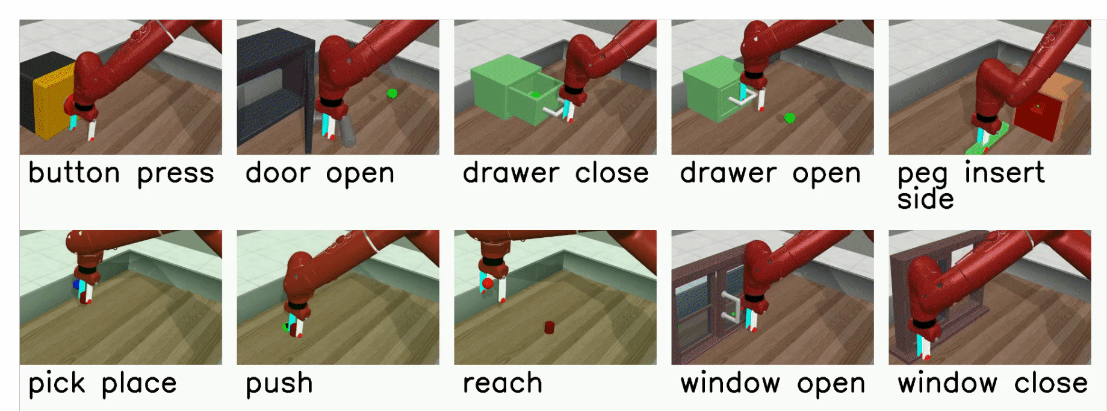
目前,机器人通常需要大量训练才能成功完成单一任务。然而,为了在现实场景中真正提升其实用性,机器人应具备有效执行多项任务的能力。为此,本文提出了一种多任务软演员评论家(MT-SAC)算法,并将其与单生命周期强化学习(MT-QWALE)相结合,以训练机器人手臂在Meta World环境中成功执行七个不同任务。实验结果表明,MT-QWALE在处理新目标位置时表现优于传统的MT-SAC算法,且在隐藏最终目标位置的情况下,MT-QWALE仍能以略多的步骤成功完成任务。
🔬 方法详解
问题定义:本文旨在解决现有多任务强化学习算法在不同环境或观察空间下的泛化能力不足的问题。现有算法在训练时对环境分布的依赖性较强,导致在实际应用中表现不佳。
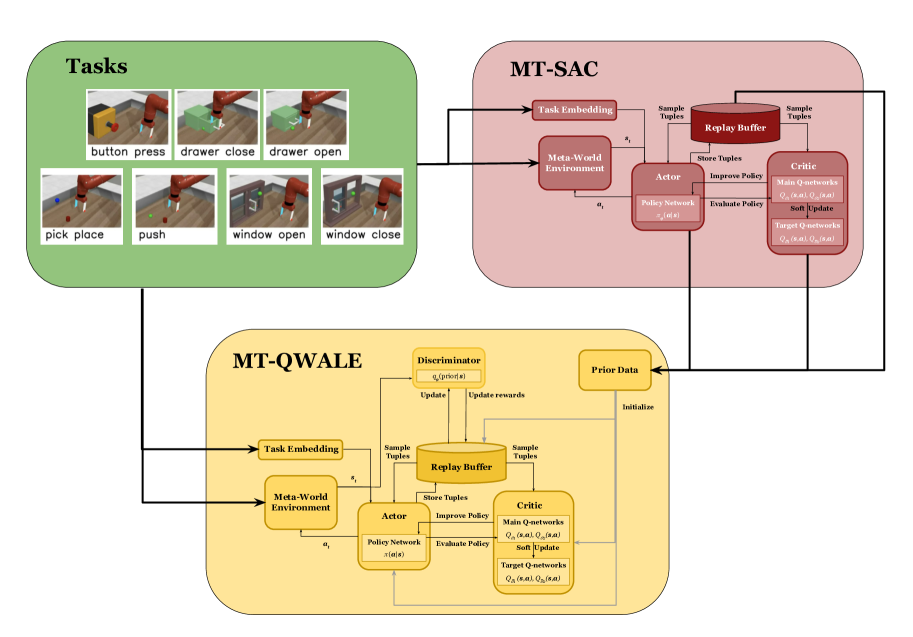
核心思路:论文提出将多任务软演员评论家(MT-SAC)与单生命周期强化学习(MT-QWALE)结合,利用MT-SAC生成的先验数据来训练机器人手臂,使其能够在Meta World环境中执行多项任务。
技术框架:整体架构包括两个主要阶段:首先使用MT-SAC训练机器人手臂以执行七个不同任务,随后将训练好的模型作为先验数据源,应用于MT-QWALE算法进行进一步优化。
关键创新:MT-QWALE算法的引入是本文的主要创新点,它通过专注于单一任务的训练来增强算法的泛化能力,与传统的多任务算法相比,能够更好地适应不同的任务环境。
关键设计:在算法设计中,关键参数设置包括学习率、折扣因子等,损失函数采用了适应性调整的策略,以确保在不同任务间的有效迁移和学习。
🖼️ 关键图片
📊 实验亮点
实验结果表明,MT-QWALE算法在处理新目标位置时的任务完成率显著高于MT-SAC,且在隐藏最终目标位置的情况下,MT-QWALE仍能以略多的步骤成功完成任务,展示了其在多任务学习中的优越性。
🎯 应用场景
该研究的潜在应用领域包括工业自动化、服务机器人和智能家居等场景。通过提升机器人在多任务环境中的操作能力,可以显著提高其在复杂和动态环境中的适应性和实用性,未来可能推动机器人技术的广泛应用。
📄 摘要(原文)
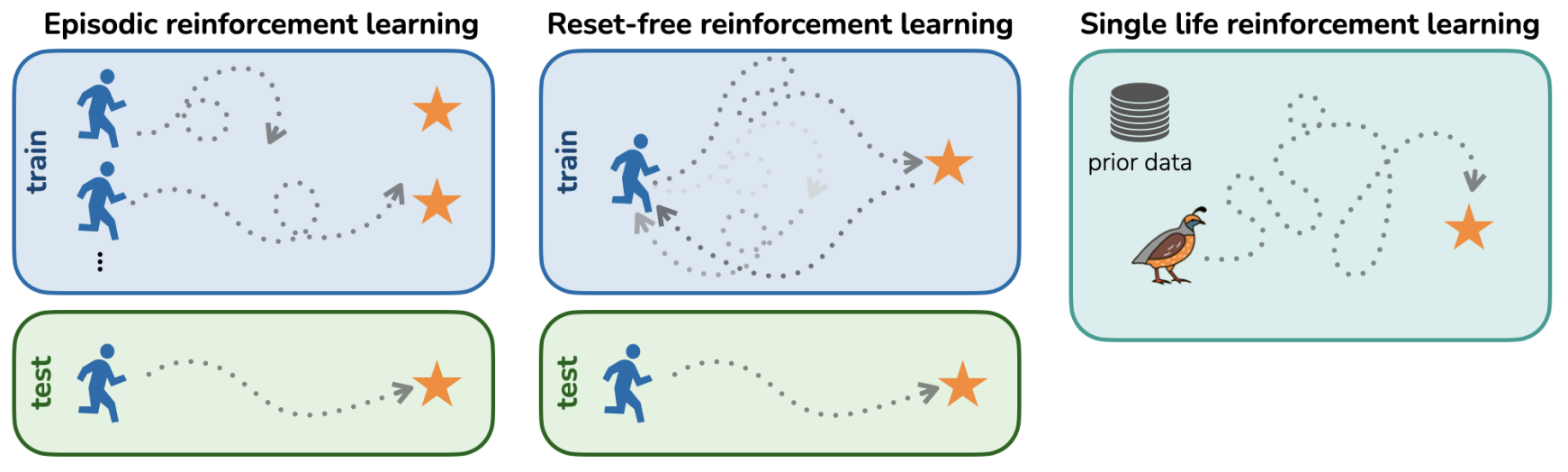
At present, robots typically require extensive training to successfully accomplish a single task. However, to truly enhance their usefulness in real-world scenarios, robots should possess the capability to perform multiple tasks effectively. To address this need, various multi-task reinforcement learning (RL) algorithms have been developed, including multi-task proximal policy optimization (PPO), multi-task trust region policy optimization (TRPO), and multi-task soft-actor critic (SAC). Nevertheless, these algorithms demonstrate optimal performance only when operating within an environment or observation space that exhibits a similar distribution. In reality, such conditions are often not the norm, as robots may encounter scenarios or observations that differ from those on which they were trained. Addressing this challenge, algorithms like Q-Weighted Adversarial Learning (QWALE) attempt to tackle the issue by training the base algorithm (generating prior data) solely for a particular task, rendering it unsuitable for generalization across tasks. So, the aim of this research project is to enable a robotic arm to successfully execute seven distinct tasks within the Meta World environment. To achieve this, a multi-task soft actor-critic (MT-SAC) is employed to train the robotic arm. Subsequently, the trained model will serve as a source of prior data for the single-life RL algorithm. The effectiveness of this MT-QWALE algorithm will be assessed by conducting tests on various target positions (novel positions). In the end, a comparison is provided between the trained MT-SAC and the MT-QWALE algorithm where the MT-QWALE performs better. An ablation study demonstrates that MT-QWALE successfully completes tasks with a slightly larger number of steps even after hiding the final goal position.