Leveraging Generative AI: Improving Software Metadata Classification with Generated Code-Comment Pairs
作者: Samah Syed, Angel Deborah S
分类: cs.SE, cs.AI, cs.CL, cs.LG
发布日期: 2023-10-14
备注: 9 pages, 2 figures, 3 tables, Has been accepted for the Information Retrieval in Software Engineering track at Forum for Information Retrieval Evaluation 2023
期刊: Information Retrieval in Software Engineering track at Forum for Information Retrieval Evaluation 2023
💡 一句话要点
利用生成式AI提升软件元数据分类的有效性
🎯 匹配领域: 支柱九:具身大模型 (Embodied Foundation Models)
关键词: 生成式AI 代码注释 BERT 机器学习 软件工程 自然语言处理 分类模型
📋 核心要点
- 现有方法在客观分类代码注释时面临挑战,难以准确区分有用与无用的注释。
- 论文提出利用生成的代码-注释对和BERT模型来自动化分类过程,增强数据集的多样性。
- 实验结果表明,使用增强数据集后,分类模型在精确度、召回率和F1分数上均有显著提升。
📝 摘要(中文)
在软件开发中,代码注释对于增强代码理解和协作至关重要。本研究论文解决了客观分类代码注释为“有用”或“无用”的挑战。我们提出了一种新颖的解决方案,利用上下文嵌入,特别是BERT,来自动化此分类过程。初始数据集包含9048对用C语言编写的代码和注释,标记为有用或无用。为了增强数据集,我们额外获取了739行代码-注释对,并使用大型语言模型架构(特别是BERT)生成标签。主要目标是构建能够有效区分有用和无用代码注释的分类模型。采用了多种机器学习算法进行评估,包括逻辑回归、决策树、K近邻、支持向量机、梯度提升、随机森林和神经网络。该研究展示了生成式AI在提升二元代码注释质量分类模型中的潜力,为软件开发者和自然语言处理及软件工程领域的研究者提供了宝贵的见解。
🔬 方法详解
问题定义:本论文旨在解决代码注释的有效分类问题,现有方法在准确性和客观性上存在不足,难以有效区分“有用”与“无用”的注释。
核心思路:通过生成代码-注释对并结合BERT模型的上下文嵌入,自动化分类过程,提升分类的准确性和效率。
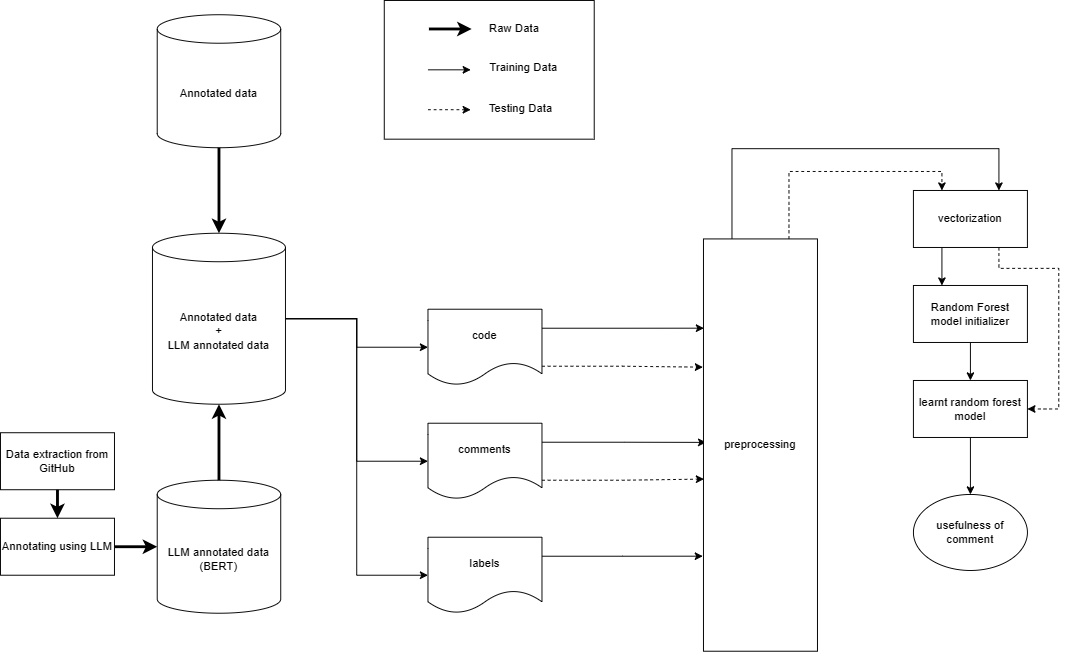
技术框架:整体架构包括数据集构建、生成模型训练、分类模型训练和评估四个主要模块。首先构建初始数据集,然后生成额外的代码-注释对,最后训练多种机器学习模型进行分类。
关键创新:最重要的技术创新在于结合生成式AI与上下文嵌入技术,显著增强了数据集的多样性和模型的分类能力,与传统方法相比,提升了分类的准确性和效率。
关键设计:在模型训练中,使用了多种机器学习算法,包括逻辑回归、决策树、KNN、SVM、梯度提升、随机森林和神经网络,评估指标包括精确度、召回率和F1分数,确保模型的全面性能。
🖼️ 关键图片

📊 实验亮点
实验结果显示,使用增强数据集后,分类模型在精确度、召回率和F1分数上均有显著提升,具体性能数据未提供,但整体提升幅度明显,验证了生成式AI在代码注释分类中的有效性。
🎯 应用场景
该研究的潜在应用领域包括软件开发工具、代码审查系统和自动化文档生成等。通过提升代码注释的分类质量,能够帮助开发者更好地理解和维护代码,提高团队协作效率,未来可能对软件工程领域产生深远影响。
📄 摘要(原文)
In software development, code comments play a crucial role in enhancing code comprehension and collaboration. This research paper addresses the challenge of objectively classifying code comments as "Useful" or "Not Useful." We propose a novel solution that harnesses contextualized embeddings, particularly BERT, to automate this classification process. We address this task by incorporating generated code and comment pairs. The initial dataset comprised 9048 pairs of code and comments written in C, labeled as either Useful or Not Useful. To augment this dataset, we sourced an additional 739 lines of code-comment pairs and generated labels using a Large Language Model Architecture, specifically BERT. The primary objective was to build classification models that can effectively differentiate between useful and not useful code comments. Various machine learning algorithms were employed, including Logistic Regression, Decision Tree, K-Nearest Neighbors (KNN), Support Vector Machine (SVM), Gradient Boosting, Random Forest, and a Neural Network. Each algorithm was evaluated using precision, recall, and F1-score metrics, both with the original seed dataset and the augmented dataset. This study showcases the potential of generative AI for enhancing binary code comment quality classification models, providing valuable insights for software developers and researchers in the field of natural language processing and software engineering.