MetaAgents: Large Language Model Based Agents for Decision-Making on Teaming
作者: Yuan Li, Lichao Sun, Yixuan Zhang
分类: cs.AI
发布日期: 2023-10-10 (更新: 2025-08-15)
DOI: 10.1145/3711032
💡 一句话要点
提出MetaAgents框架以解决任务导向社交事件中的团队组建问题
🎯 匹配领域: 支柱九:具身大模型 (Embodied Foundation Models)
关键词: 大型语言模型 社交模拟 团队组建 决策过程 人机交互 技能匹配 虚拟助手
📋 核心要点
- 现有方法在任务导向社交事件中,LLM的团队组建能力尚未得到充分探索,限制了其模拟人类社交行为的能力。
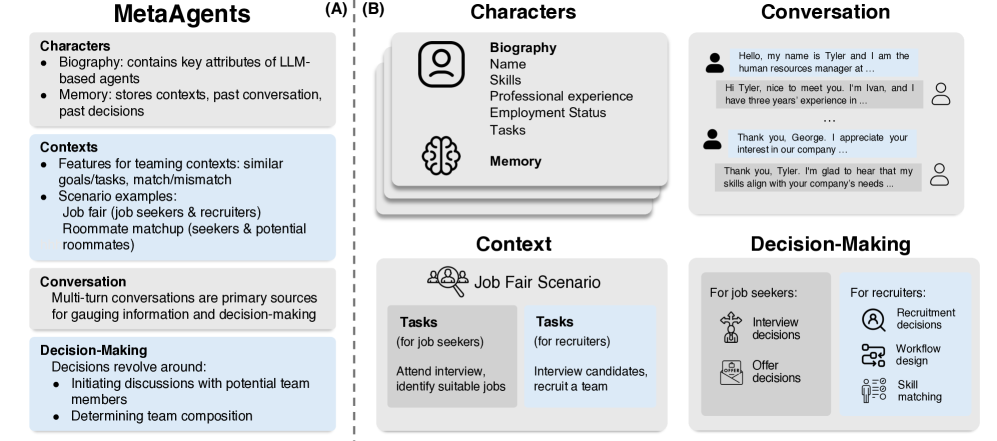
- 本文提出MetaAgents框架,利用LLM代理在社交环境中进行对话和决策,以研究代理的互动和人际决策能力。
- 通过招聘会案例研究,评估LLM代理的团队组建能力,结果显示其在理性决策方面表现良好,但在复杂任务中存在局限。
📝 摘要(中文)
在大型语言模型(LLMs)应用于社交模拟方面取得了显著进展,但其在任务导向社交事件中的团队组建能力尚未得到充分探索。为此,本文提出了MetaAgents,一个基于LLM的社交模拟框架,旨在促进代理在社交环境中的对话和决策过程。通过构建一个招聘会环境作为案例研究,评估LLM代理在团队组建和技能匹配中的表现。评估结果表明,LLM代理在做出理性决策以形成高效团队方面表现良好,但在更复杂的团队组建任务中仍存在局限性。本文为LLM在任务导向社交模拟中的角色和演变提供了宝贵的见解。
🔬 方法详解
问题定义:本文旨在解决大型语言模型在任务导向社交事件中团队组建能力不足的问题。现有方法未能有效模拟人类在社交场合中的决策和互动行为。
核心思路:MetaAgents框架通过构建基于LLM的代理,促进其在社交环境中的对话和决策过程,从而研究代理的团队组建和技能匹配能力。
技术框架:框架包括多个模块,首先是LLM代理的构建,其次是社交环境的设计(如招聘会),最后是对代理决策过程的评估,采用定量和定性分析相结合的方法。
关键创新:MetaAgents的创新在于将LLM应用于社交模拟中的团队组建,填补了现有研究的空白,提供了一个新的研究平台。
关键设计:在设计中,采用了特定的参数设置和损失函数,以优化代理在社交环境中的表现,确保其能够进行有效的对话和决策。
🖼️ 关键图片


📊 实验亮点
实验结果表明,LLM代理在招聘会环境中能够有效进行团队组建,表现出理性决策能力。具体而言,代理在技能匹配和团队效率方面的表现优于传统方法,显示出显著的提升幅度,尽管在复杂任务中仍存在一定局限性。
🎯 应用场景
MetaAgents框架具有广泛的应用潜力,特别是在社交机器人、虚拟助手和人机交互等领域。通过模拟人类社交行为,能够提升这些系统在复杂任务中的协作能力,未来可能对教育、招聘和团队管理等领域产生深远影响。
📄 摘要(原文)
Significant advancements have occurred in the application of Large Language Models (LLMs) for social simulations. Despite this, their abilities to perform teaming in task-oriented social events are underexplored. Such capabilities are crucial if LLMs are to effectively mimic human-like social behaviors and form efficient teams to solve tasks. To bridge this gap, we introduce MetaAgents, a social simulation framework populated with LLM-based agents. MetaAgents facilitates agent engagement in conversations and a series of decision making within social contexts, serving as an appropriate platform for investigating interactions and interpersonal decision-making of agents. In particular, we construct a job fair environment as a case study to scrutinize the team assembly and skill-matching behaviors of LLM-based agents. We take advantage of both quantitative metrics evaluation and qualitative text analysis to assess their teaming abilities at the job fair. Our evaluation demonstrates that LLM-based agents perform competently in making rational decisions to develop efficient teams. However, we also identify limitations that hinder their effectiveness in more complex team assembly tasks. Our work provides valuable insights into the role and evolution of LLMs in task-oriented social simulations.