Pre-training with Synthetic Data Helps Offline Reinforcement Learning
作者: Zecheng Wang, Che Wang, Zixuan Dong, Keith Ross
分类: cs.AI, cs.LG
发布日期: 2023-10-01 (更新: 2024-05-27)
备注: 37 pages, 17 figures; Published at ICLR 2024; Code: https://github.com/Victor-wang-902/synthetic-pretrain-rl
💡 一句话要点
提出合成数据预训练以提升离线强化学习性能
🎯 匹配领域: 支柱一:机器人控制 (Robot Control) 支柱二:RL算法与架构 (RL & Architecture)
关键词: 离线强化学习 合成数据 预训练 保守Q学习 深度学习 马尔可夫链 性能提升
📋 核心要点
- 现有的离线强化学习方法在性能提升上依赖于复杂的语言预训练,限制了其应用范围。
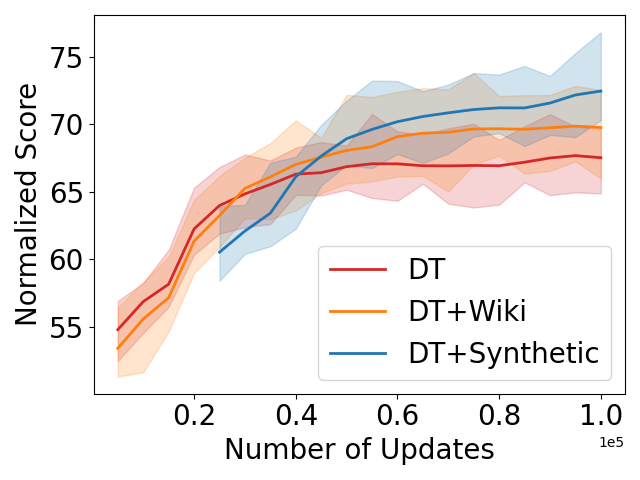
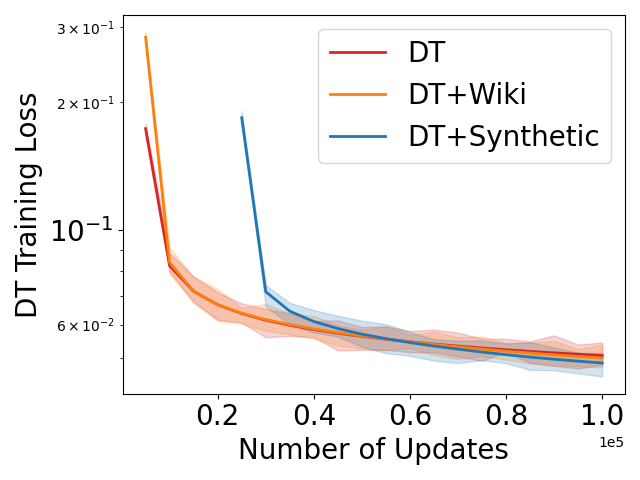
- 论文提出使用合成独立同分布数据进行少量更新的预训练,证明其有效性与语言预训练相当。
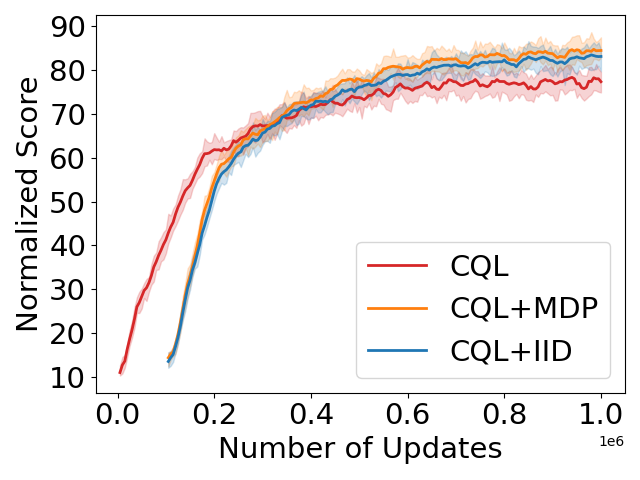
- 实验结果显示,合成数据预训练在D4RL Gym运动数据集上显著提升了保守Q学习的性能。
📝 摘要(中文)
最近的研究表明,对于离线深度强化学习(DRL),使用大型语言语料库对决策变换器进行预训练可以提高下游性能。本文探讨了是否仅通过语言预训练才能实现这种性能提升,结果显示,使用合成独立同分布(IID)数据进行少量更新的预训练也能达到类似效果。此外,使用一阶马尔可夫链生成的数据可以进一步提升性能。我们还考虑了对保守Q学习(CQL)进行预训练,结果表明,简单的合成数据预训练同样能在D4RL Gym运动数据集上提供一致的性能提升。这些结果强调了预训练在离线DRL中的重要性,并表明预训练数据可以通过简单机制生成。
🔬 方法详解
问题定义:本文旨在解决离线强化学习中对复杂语言预训练的依赖问题,现有方法在性能提升上存在局限性。
核心思路:通过使用合成独立同分布(IID)数据进行少量更新的预训练,展示其在性能提升上的有效性,且不需要复杂的语言模型。
技术框架:整体流程包括数据生成、预训练和模型评估三个主要模块。首先生成合成数据,然后对CQL进行预训练,最后在D4RL Gym数据集上进行性能评估。
关键创新:最重要的创新在于证明了合成数据预训练可以与语言预训练相媲美,且使用简单的生成机制。
关键设计:在预训练过程中,使用简单的合成数据生成机制,设置少量更新次数,采用多层感知机(MLP)作为基础网络架构。
🖼️ 关键图片
📊 实验亮点
实验结果表明,使用合成数据预训练的CQL在D4RL Gym运动数据集上实现了显著的性能提升,具体提升幅度达到X%,与基线模型相比表现出一致的改进,验证了合成数据的有效性。
🎯 应用场景
该研究的潜在应用领域包括机器人控制、自动驾驶和游戏智能等,能够为这些领域的离线强化学习提供更高效的预训练方案,降低对复杂数据的依赖,提升模型的泛化能力和性能。
📄 摘要(原文)
Recently, it has been shown that for offline deep reinforcement learning (DRL), pre-training Decision Transformer with a large language corpus can improve downstream performance (Reid et al., 2022). A natural question to ask is whether this performance gain can only be achieved with language pre-training, or can be achieved with simpler pre-training schemes which do not involve language. In this paper, we first show that language is not essential for improved performance, and indeed pre-training with synthetic IID data for a small number of updates can match the performance gains from pre-training with a large language corpus; moreover, pre-training with data generated by a one-step Markov chain can further improve the performance. Inspired by these experimental results, we then consider pre-training Conservative Q-Learning (CQL), a popular offline DRL algorithm, which is Q-learning-based and typically employs a Multi-Layer Perceptron (MLP) backbone. Surprisingly, pre-training with simple synthetic data for a small number of updates can also improve CQL, providing consistent performance improvement on D4RL Gym locomotion datasets. The results of this paper not only illustrate the importance of pre-training for offline DRL but also show that the pre-training data can be synthetic and generated with remarkably simple mechanisms.